

How To Draw Background Snowy Trees
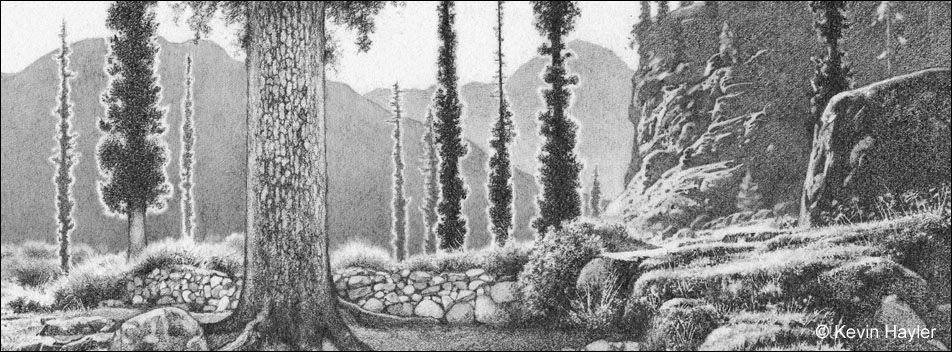
So many people find cartoon a forest intimidating but as we will run across it's far easier than you recall. If you want to learn how to depict a forest groundwork, this post will show you how to make your forest drawing await convincing.
Describe woods backgrounds in the far distance equally one unified shape. Lighten the tone to add together depth to the cartoon. Erase gaps in the leaf. Shade the canopy, don't describe the leaves. Vary the slant of the tree trunks and brand them slightly wider at the base of operations.
Sounds like shooting fish in a barrel enough in theory but how does information technology stack up in practice? Let'southward discover out how to draw forest backgrounds in the simplest way.
(I become commissions for purchases made through links in this post. However, I only promote products I similar and recommend)
How to Draw a Forest Background in the Far Distance
All landscapes are shaped by the light, and that changes throughout the day and according to the season. Wintertime trees under a depression sun with long shadows are going to look very different from a leafy wood at the acme of summertime.
Given the obvious variables, drawing a forest background on the horizon line volition adapt to a pattern. I'chiliad reluctant to say 'rules', permit's call them guidelines.
Typically, a line, or bank of copse, will appear to the naked middle as i mass. The individual features are lost in the whole. The canopy line can be disjointed and broken, just the tonal values will remain the same.
Distant trees will generally be more convincing when the tonal values are lightened.
The line of woods copse tin can exist rendered in different means co-ordinate to your medium. A thin canopy line may exist enough for a pen and ink sketch, while a wall of halftone would await more convincing using a pencil.
Interesting trees are not neat and tidy, they are irregular and broken. It looks far more than realistic to have a depository financial institution of trees interspersed with taller or stand-solitary specimens.
Solid shapes may appear in the skyline, but any trees within a reasonable distance, close enough to discern some detail, will take gaps in the canopy. Adding a few holes in the leaf and stray branches will add authenticity to the forest.
Don't exist a slave to reality. If a solid line of forest copse looks meliorate with breaks, add together them. Call it creative license. You lot are non drawing reality, you lot are drawing an illusion of reality and the public loves the romance, and so give information technology to them.
Read this: How To Sell Landscape Paintings: 13 Ways to Brand More Money
How to Draw a Wood as a Backdrop
Cartoon a forest background or properties will require a more thoughtful arroyo. The emphasis must notwithstanding be on defining the silhouette only now you'll demand to strive for more than accuracy. Take the tiger drawing below as a expert example.

The forest background was fabricated to look existent. The real setting was quite different. I wanted her to stand out more and then I thought I'd take her out of the jungle and onto the forest edge.
At starting time, I drew some trees only from my imagination. They were OK but it occurred to me that they may not look anything like accurate rainforest trees.
I flicked through some references and realized that the main difference between my imagined copse and the real ones was the amount of leafage hanging from the tree trunks. With a few small-scale adjustments, the background woods looked much meliorate.
For more insight read this: Is Drawing From Reference Photos Bad? Are You Adulterous?
Y'all will also note how I've used an eraser to remove some larger gaps in the leaves. Information technology was all guesswork but by imagining how the branches splayed out and reduced in width equally they rise to the top, I've made the copse look real.
You can too run into how I've used a blunt pencil to highlight the grain in the paper. I haven't drawn any leaves simply you however have the leafy impression. Tin can you lot see how I've used random cantankerous-hatching to shade the trees? It works to give them a faraway out-of-focus feel.
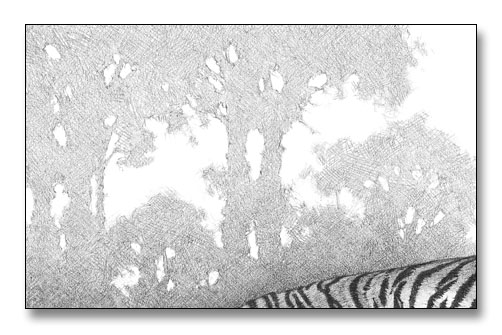
The tone is also fairly flat. It darkens towards the base as it transitions into the more than detailed woods flooring. In truth, I was in 2 minds how to do this. I could just as easily have lightened this surface area and unsaid a mist. It might have looked better, who knows? Too tardily at present.
How to Describe a Forest Tree
I drew this tree almost xxx years ago. The tree is nonetheless very pleasing afterwards all these years although I should ditch the figure.
It looks complicated but it wasn't at all. When you break it down, it'south just a few major shapes in high contrast.

There are a couple of elementary tree trunks and a block of very dark leaf. But i very small cluster of leaves is highlighted. Look how the cast shadow over the tree trunks contrasts confronting the much lighter bawl.
Notice how the summit of the dead tree on the right stands out against the darkest shadow and as your eye moves up the main tree, information technology splits into 2 huge pillars and lights upward confronting the foliage. The twin branches disappear into the shadowed crown and lose definition.
The shadows work well. They are dark on the edges and lighter in the middle. They make the tree expect 3D.
This post will show you: How to Describe Realistic Shadows in Pencil (All The Best Secrets)
I've used soft graphite pencils. It was a long time ago merely I tin exist pretty sure that the tree was fatigued with a 3B.
I saw this beautiful tree in Flores Republic of indonesia, in 1990. No doubt this was a remnant tree from the forest that existed there one-time in the past. I wonder if it'southward still there. I hope then.
How to Draw Background Winter Trees
I haven't drawn background winter copse in ink for many years but no thing because Arthur Rackham drew copse in ink better than I ever did.

He loved to play around with the twisting forms of wintertime trees. Although his illustrations are stylized and mostly appeared in children's books they ooze atmosphere and bodacious skill.
He used bolder lines for the foreground copse and used a lighter impact with thinner lines for the background trees. He simplified everything. You lot can run across how he refrained from adding every twig and co-operative. He has drawn but those details that convey the message.
You can likewise run into how he liked to mirror the sweeping curves of his trees with an undulating horizon. It all comes together as a whole. Brilliant

My cartoon of the wintertime tree to a higher place is not simplified plenty. it'south a classic case of being wednesday to the truth. I should've improvised more. That said, I did movement the pony backside the tree, information technology was originally standing to one side.
Winter trees are more atmospheric than copse in full foliage. They have an abstract entreatment that Arthur Rackham used to total effect.
Listen up, if you desire to turn your hobby into a business you can. I've got a guide that will assistance you. Take a look.

If Yous Want to Sell Your Art
Cheque this out!
Psst…it's only $12.99!
How to Draw a Forest Groundwork in an Interesting Style
I've mentioned how erasing gaps in betwixt the foliage brings the silhouette to life but there are plenty of hacks.
Read this: How to Make Your Drawings Interesting: xiv Ways to Amend a Cartoon
Don't Be a Slave to the Truth
In many ways, perfection and truth are your enemies. It is then easy to get blinded and become a slave to reality. This is particularly truthful when y'all work from photographic references.
The skill is in angle the truth to suit the cartoon.
When you are in the field it'due south easy to step to one side and expect around an object that gets in your way. Y'all simply pretend the obstruction wasn't there. Removing an object in a photograph, on the other hand, leaves a blank infinite and information technology seems easier just to depict it in.
When information technology comes to drawing background forests and landscapes, yous are almost obliged to edit the scenes. Was at that place ever a perfect view that didn't involve finding a convoluted angle or perspective? And in that location's always something in the manner.
Parked cars, route signs, pylons, and at present wind farms ruin the view. You name it, the modern world steps in and trashes the scenery.
Here in the south of England where I alive, nigh of the tumble-down old buildings have long been renovated and the country lanes are neatly tarmacked. There is precious footling remaining in the fashion of 18-carat rustic charm.
That's why artistic license should exist your constant companion. You have full permission to correct the impairment.
We want the countryside that was there in our youth. If that ways leaving things out, calculation things in, and shifting things around, so what?
Does anyone really think John Constable really saw 'The Hay Wain' as perfectly every bit he painted information technology? Of course not, it'due south a contrivance. Nosotros in the modern globe must do the same and then get further.
Add together, Subract, and Fabricate
The key to making a landscape interesting is to remove the perfection. Directly lines and perpendiculars are soulless. Get rid of them
No one wants a lollipop tree, manicured and pruned to death. They want a beautifully twisted tree, knarled, and leaning over.
If it isn't interesting, just cheat a scrap.
Ane of the easiest things you lot can practice is tilt the trees. A deadening scene can spring into life just because you played around with a few slanting verticals. Give them some jaunty swagger.
No dead branches? add them, no owl holes? put them in, wrong calorie-free? change it!
And don't cease there, if you find that perfect clump of trees in the wrong identify, move them over if the composition demands it. Exist creative and adapt. JMW Turner didn't worry virtually the truth and it shouldn't worry y'all.
I tin understand that some artists might be reticent near changing a rural scene besides much. A local view has got to resemble the real thing later on all, particularly if it'southward a archetype landmark. There is, however, no such constraint drawing a woods background in the wild.
If anything y'all will have to get into opposite. Truthful wilderness is a delightful mess and you volition have to remove some natural clutter, open upwardly the views, and simplify the scene. Some selective logging might be necessary.
How to Draw Forest Reflections in the Background
Wood reflections are not and then difficult. When in doubtfulness at that place is a simple rule of thumb that usually works.
Darks reverberate lighter and lights reflect darker
It generally holds true. Information technology'due south so convincing that you can add together a fictitious lake to a scene and make the reflections look totally genuine. When I first started to paint for a living and needed some extra cash, I would do just that. I knew how to pigment trees and reflections without any references. I could pigment it by formula.
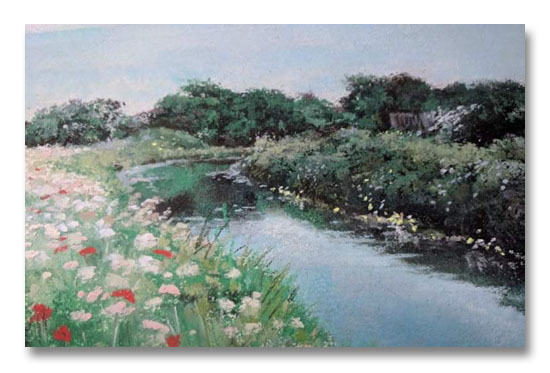
A afar bank of copse can exist flipped over and the mirror image is drawn without item. All you have to remember is to flip the trees from the base, wherever they are in the mural.
There are some simple rules for: How to Draw Water in Pencil: Drawing Water The Correct Way
In other words, if the trees are prepare back from the riverbank and there is some land in between, but part of the forest reflection will be visible in the h2o.
Reflections first at the base of operations of an object
You don't take to reinvent a landscape you tin can flood it. I used to live in a valley that would overflowing every winter. The trees, fences, and farm gates would stand up in a foot of water for days or even weeks at a fourth dimension. The reflections were magical.
How to Create Depth With a Forest Background
Drawing a background forest can frame a subject and requite it context. There's usually but not ever, a central characteristic in a drawing, and the remainder of the picture show compliments the focal point and provides a compositional residuum.
Ideally, your background forest trees will recede seamlessly into the altitude. In that location are two classic means to indicate depth, progressively lighter tones, and smaller sizes.
Every bit trees disappear towards the horizon they mostly brume over. You can employ this rule to your advantage. Background trees might exist confused in existent life but when y'all depict in the chief shapes you can deliberately exaggerate the closer trees by making them darker.
Build circuitous shapes up in layers from light to dark.
Every bit a rule, trees will look smaller in the altitude, always bearing in mind that some trees on the same horizon line will grow bigger. You lot have to depict what you encounter and not but what you know to be true.
The illusion of depth can also exist accomplished with silhouettes. There is no need to add so much detail to the leaves in distant trees, sometimes it is ameliorate to bespeak the tree in contour with simple shading.
Cheque this out if you need more tips: How to Create Depth in Your Drawing: seven Expert Techniques
Photographers are particularly smashing to photograph trees silhouetted in fog. You don't take to wait for a foggy day to create the same event, you lot tin can concoct information technology.
Drawing distant trees in pastel presents the added problem of using colour. Every bit a rule, adding a blue cast to distant trees will make them recede into the background.
In certain weather condition, distant trees volition accept a purple tint. Exist careful, purple is a stiff color and contains cerise. Mute the color with grey.
Art Materials for Drawing Forest Backgounds
Drawing Pencils
I utilize Derwent Graphic Pencils (affiliate) 3B, B, HB, 2H, and 4H. They are the standard drawing pencils I want to have ready.
I also employ Pentel Mechanical Pencils 0.3mm (affiliate) 2B, B, HB, 2H, and 4H leads. I rarely utilise the wider grades but that is but because my drawings are on the small side and in that location is no need.
I explain everything here: What Do Pencil Numbers Mean? Pencil Grades Explained + Charts
First and foremost, I'g a graphite artist and that's my real expanse of expertise. I use both Derwent Graphic Drawing Pencils and Pentel Mechanical Pencils (affiliate links). They are my preference but don't feel that they are essential.
Purchase a good pencil brand and stick with them. Buy a brand of pencils that supply individual pencils. The last thing you need is to run out of a grade and be forced to purchase a new set just to replace ane item.
If I didn't utilise Derwent I would buy Staedtler or Faber-Castell (affiliate links). They are available all over the world.
I chose Pentel mechanical pencils considering they were reasonably priced. They have a broad range of leads but you must remember that each class and width of lead requires a carve up pencil holder.
This can get expensive simply yous only need to buy them once. Subsequently that, you are only buying atomic number 82 refills. I used to accept a reliable supply locally but as with so much in life these days, I take been forced to buy replacements online in the last few years.
Y'all should read this: Can Y'all Draw With Mechanical Pencils? Yep, and Here's How
In general, I utilise softer grades to draw the leafage. As the forest recedes into the distance I use a combination of a lighter touch and harder grades.
On occasion, I volition also utilise a 4B or 6B graphite stump (chapter). I use them to castor the surface and create random grainy patterns. They simulate twigs and leaf. Use them sparingly because they don't erase well and leave graphite shine.
Pencil Erasers
I mainly utilize a kneadable Putty Eraser (chapter). Not so much for erasing mistakes, more for lifting out the texture. As well, I use Blu Tack (affiliate) to dab at the graphite, it kneads to a fine signal and lifts off tone cleanly. Y'all don't rub with Blu Tack (chapter).
For fine lines, I use a Tombo Mono Eraser Pen . (chapter)
For precision erasing I utilise a Jakar Bombardment Eraser (affiliate). I apply them to lift out gaps in the canopy. They are the best erasers for restoring the newspaper surface back to its original state.
If you desire to know: How to Describe White Lines in a Pencil Drawing (Without Going Mad)
Pencil Sharpeners
I employ a standard pencil sharpener (affiliate). I will apply a craft knife (affiliate) sometimes but I don't require a long lead for my techniques. Information technology'southward a thing of preference.
I practice use a pocket-size sheet of 'Moisture and Dry out' fine sandpaper (chapter) to keep the tip sharp. I will twist a nib over the surface every few minutes. It's a proficient habit to get into.
I too utilise the same sandpaper for my Pentel pencils, but this fourth dimension I apply them to chamfer the bill. For the most function, I use the flat plane of the chamfer to draw. If I need a razor-sharp line I will twist the end and apply the tip.
Drawing Paper
I like using a Daler-Rowney Heavyweight Cartridge Paper (chapter) considering it's a good all-rounder. The tooth binds the graphite and you can get a rich night line. It besides allows you lot to create very smooth blended tones, ideal for clouds and still water.
I utilize Canson Mi-Teintes paper (affiliate) if I want a rougher feel. The advantage of using coarse paper is instant texture. Tree foliage volition look authentic instantly as your graphite highlights and extenuates the grain.
A tinted paper is a adept option. I used a mid-grey Canson Mi-Teintes (affiliate) for my pastel landscapes. Strathmore (chapter) makes a not bad mid-grey drawing paper in their 400 and 500 series. They are ideal for sketching and adding white highlights.
At that place'south more info here: What's The Right Newspaper for Pencil Drawing? (How to Choose Wisely)
I don't use Bristol lath (chapter) but many artists seem to love it. If y'all don't already know, Bristol lath is perfectly smoothen and has no molar, or grain, whatsoever. It'due south possible to alloy graphite with a subtlety almost impossible to achieve with other papers.
I don't apply information technology considering, without a grain, I can't create textural furnishings and the graphite doesn't bind to the surface. The lines are pale and information technology'due south hard to make rich nighttime tones. It is withal suited to pen and ink and if that is your preferred medium it could exist the all-time paper for you.
In the days that I drew with pen and ink. I drew on a Daler illustration lath with a 'Not' surface.
Permit me explain the jargon. Hot-pressed newspaper is shine watercolor paper, and 'not' indicates that it's non smooth. It'due south a convoluted way of saying it has texture.
I like to draw on fine-grained newspaper and the board takes watercolor washes
Drawing a Background Forest – Final Thoughts
The best flake well-nigh drawing trees, including drawing a forest background in a landscape, is how forgiving information technology is when things go incorrect. You take endless scope for making errors. You lot can modify and alter anything you like. No one will ever know or care.
When I painted landscapes, years ago, I couldn't walk in the countryside without seeing new landscapes, and potential pictures, everywhere. I was never brusk of ideas.
If y'all're stuck for inspiration: Cartoon Ideas for Adults: 120 Absurd and Piece of cake Things to Draw
If y'all're a beginner, there is no better mode of building your confidence than to start by cartoon trees in a landscape. Not just will your cartoon skills not exist then critical, but also your compositions will improve immeasurably.
Whatever your level, I promise this article has given y'all a fresh insight into creating convincing trees and forest backgrounds.
If you like the way I draw and desire to effort things for yourself, this is my basic kit: (Amazon affiliate links)
- Pentel Mechanical Pencils 0.3mm
- Derwent Graphic Drawing Pencils
- Daler-Rowney Heavyweight Cartridge Newspaper
- Jakar Battery Eraser
- Tombo Mono Eraser Pen
- Faber Castell Putty Eraser
- Blu Tack
- French Box Easel
If you want to sell your art yous should really look at this guide!
If You Desire to Sell Your Art
Check this out!
Psst…information technology's only $12.99!
- How to Find Your Own Fine art Style. Information technology'southward Easier Than You lot Think
- How to Forbid Your Drawings From Smudging
- Tracing Art – Is It Skilful or Bad? When Is Tracing Cheating and Is It Ever OK?
- How to Become Better at Drawing: fifteen Ways to Ameliorate Your Art
- Can Y'all Copy Fine art and Sell a Painting of a Painting?
Pin It AND Salvage It


Source: https://www.wildlifeartstore.com/how-to-draw-a-forest-background/
Posted by: anthonyeposis.blogspot.com
0 Response to "How To Draw Background Snowy Trees"
Post a Comment