

How Does The Author Use Atticus's Statement To Draw Our Attention To Racism In The South?
In our series, Guide to the classics, experts explain central works of literature.
Harper Lee's To Kill A Mockingbird is ane of the classics of American literature. Never out of print, the novel has sold over forty million copies since it was first published in 1960. It has been a staple of high school syllabuses, including in Australia, for several decades, and is frequently deemed the archetypal race and coming-of-age novel. For many of us, it is a formative read of our youth.
Baca juga: 'Nifty books', nationhood and instruction English language literature
The story is set in the sleepy Alabama town of Maycomb in 1936 - 40 years later the Supreme Courtroom'southward notorious proclamation of the races as being "separate but equal", and 28 years before the enactment of the Civil Rights Human activity. Our narrator is 9-twelvemonth-old tomboy, Sentinel Finch, who relays her observations of her family's struggle to bargain with the class and racial prejudice shown towards the local African American customs.
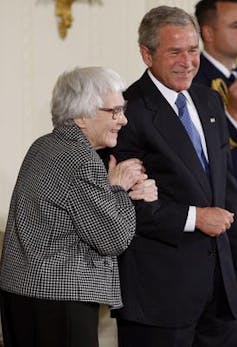
At the centre of the family and the novel stands the highly principled lawyer Atticus Finch. A widower, he teaches Sentinel, her older brother Jem, and their imaginative friend Dill, how to alive and behave honourably. In this he is aided by the family's hardworking and sensible blackness housekeeper Calpurnia, and their kind and generous neighbour, Miss Maudie.
It is Miss Maudie, for example, who explains to Scout why information technology is a sin to kill a mockingbird: "Mockingbirds don't do 1 thing but brand music for usa to savour. They don't eat upwards people'south gardens, don't nest in corncribs, they don't practise one thing but sing their hearts out for united states."
Throughout the novel, the children grow more enlightened of the customs's attitudes. When the book begins they are preoccupied with communicable sight of the mysterious and much feared Boo Radley, who in his youth stabbed his father with a pair of scissors and who has never come out of the family house since. And when Atticus agrees to defend Tom Robinson, a blackness homo who is falsely accused of raping a white woman, they besides become the target of hatred.
A morality tale for mod America
Ane might wait a book that dispatches moral lessons to exist dull reading. Just To Kill a Mockingbird is no sermon. The lessons are presented in a seemingly effortless manner, all the while tackling the complexity of race issues with startling clarity and a strong sense of reality.
Baca juga: William Faulkner diagnosed modern ills in As I Lay Dying
As the Finches return from Robinson's trial, Miss Maudie says: "every bit I waited I idea, Atticus Finch won't win, he can't win, but he'south the only human being in these parts who tin can keep a jury out and so long in a case like that."
Despite the tragedy of Robinson's conviction, Atticus succeeds in making the townspeople consider and struggle with their prejudice.
The effortlessness of the writing owes much to the way the story is told. The narrator is a grown Scout, looking back on her babyhood. When she begins her story, she seems more interested in telling u.s. well-nigh the people and incidents that occupied her half dozen-year-old imagination. Only slowly does she come up to the events that changed everything for her and Jem, which were set up in motion long before their fourth dimension. Fifty-fifty then, she tells these events in a way that shows she as well young to always grasp their significance.
The lessons Lee sets out are encapsulated in episodes that are as funny as they are serious, much like Aesop'south Fables. A case in indicate is when the children render home from the school concert with Scout even so dressed in her outlandish ham costume. In the nighttime they are chased and attacked by Bob Ewell the begetter of the woman whom Robinson allegedly raped. Ewell, armed with a knife, attempts to stab Scout, just the shapeless wire cage of the ham causes her to loose remainder and the knife to get astray. In the struggle that ensues someone pulls Ewell off the teetering body of Scout and he falls on the knife. It was Boo Radley who saved her.
Another lesson about what it means to exist truly brave is delivered in an enthralling episode where a local farmer's dog suddenly becomes rabid and threatens to infect all the townsfolk with his deadly drool.
Scout and Jem are surprised when their bespectacled, bookish begetter turns out to have a "God-given talent" with a rifle; it is he who fires the unmarried shot that will render the townsfolk safe. The children rejoice at what they consider an impressive display of courage. However, he tells them that what he did was not truly dauntless. The meliorate example of courage, he tells them, is Mrs Dubose (the "mean" old lady who lived down the road), who managed to cure herself of a morphine addiction fifty-fifty equally she was dying a horribly painful death from cancer.

He also teaches them the importance of behaving in a civilised manner, even when subjected to insults. Most of all Atticus teaches the children the importance of listening to one's censor fifty-fifty when everyone else holds a opposite view: "The ane thing that doesn't bide by majority dominion", he says, "is a person's conscience."
The continuing value in Atticus' belief in the importance of principled thinking in the world of Blackness Lives Affair and the Australian government's rhetoric of "African gangs", is clear.
Atticus' spiel on "conscience" and the other ethical principles he insists on living by, are key to the indelible influence of the novel. It conjures an platonic of moral standards and man behaviour that many people still aspire to today, even though the novel's events and the characters belong to the by.
Lee herself was not one to shy away from principled displays: writing to a school that banned her novel, she summed upward the source of the morality her book expounds. The novel, she said, "spells out in words of seldom more than two syllables a code of honor and deport".
Fame and obscurity
When first published the novel received rave reviews. A yr later on it won the Pulitzer Prize for Literature, followed past a movie version in 1962 starring Gregory Peck. Indeed, the novel was such a success that Lee, unable to cope with all the attention and publicity, retired into obscurity.
Interviewed late in life, Lee cited two reasons for her continued silence: "I wouldn't go through the pressure and publicity I went through with To Kill a Mockingbird for any amount of money. 2d, I have said what I wanted to say, and I volition non say it again."
The latter statement is doubtless a reference to the autobiographical nature of her volume. Lee passed her babyhood in the rural town of Monroeville in the deep south, where her attorney begetter dedicated two black men accused of killing a shopkeeper. The accused were convicted and hanged.
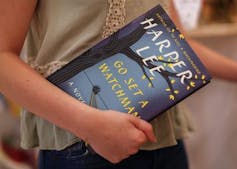
Undoubtedly influenced by these formative events, the biographical fiction Lee drew out of her family history became yet more complex upon the publication of her just other novel, Go Set a Watchman, in 2016. Critics panned it it for defective the light affect and humour of the first novel. They too decried the fact that the character of Atticus Finch was this time effectually a racist bigot, a feature that had the potential to taint the author's legacy.
Baca juga: Review/ Has Go Fix a Watchman helped topple the notion of the white saviour?
Subsequent biographical research revealed that Go Set A Watchman, was not a sequel, but the kickoff draft of To Kill a Mockingbird. Following initial rejection past the publisher Lippincot, Lee reworked information technology into the superior novel many of united states of america know and still beloved today.
Lee gave us the portrait of one small town in the due south during the depression years. Just it was so filled with lively particular, and unforgettable characters with unforgettable names similar Atticus, Scout, Calpurnia and Boo Radley that a universal story emerged, and with it the novel's continuing popularity.

Source: https://theconversation.com/how-the-moral-lessons-of-to-kill-a-mockingbird-endure-today-100763
Posted by: anthonyeposis.blogspot.com
0 Response to "How Does The Author Use Atticus's Statement To Draw Our Attention To Racism In The South?"
Post a Comment